Funny thing about revenue models


Excerpt:

Back in March, when Amazon released their own Android Appstore, I made the case for why Amazon now had to release their own Android-powered devices. Simply put, the process to install the Android appstore is way too complicated, Amazon needs devices they can ship with the store pre-installed. And more importantly, their storespre-installed. As in, any device they ship is going to be filled with Amazon to the brim. That includes the ability to sign in to your Amazon Prime account the buy things with one click.

When that happens, Amazon will have an Android tablet that is more compelling than any other Android tablet on the market on day one. There are plenty of whispers of Google planning their own “Nexus” tablet for later this year when the Ice Cream Sandwich variety of Android is ready to go, but the consumer ease-of-use that Amazon can offer will likely trump anything Google puts out there.


Sent from Mobile

Posted via email from Pete's posterous

Khan Academy iPad app screenshots show progress


Excerpt:

The Khan Academy is an online non-profit organization whose goal is to provide a "free world-class education to anyone anywhere." Think of it as TED for everyone, except Khan's videos, resources, and lesson plans can actually help you be one of the TED speakers one day. Currently the Khan Academy is only accessible through a browser, but, John Resig, Dean of Open Source and head of JavaScript development at the non-profit, has shown off a few alpha screenshots of the upcoming Khan Academy iPad app, and it looks awesome.

Initially the 1.0 version of the iPad app will allow video navigation and viewing, interactive transcripts, and offline support. However, future versions of the iPad app will allow for in-app exercises. No word yet on a release date for the app, but combining the Khan Academy with the iPad could prove to be a truly disruptive combination of technologies for traditional education. And especially with kids coming out of US colleges with upwards of $150,000 in student debt, perhaps our more traditional education models need to be disrupted.


Sent from Mobile

Posted via email from Pete's posterous

JotJournal turns your Facebook posts


JotJournal turns your Facebook posts & pics into a keepsake book

Those posts, pics and musings on Facebook capture our daily lives. But do they really get captured? Pretty soon they're at the bottom of our "feed," lost forever.  Not anymore. JotJournalcompiles the best moments from your Facebook page (skip the ones you'd, uh, rather forget) and turns them into a keepsake book - all with just a few clicks. 

Sent from Mobile

Posted via email from Pete's posterous

Kia: Design + Fundamentals

http://www.usatoday.com/money/autos/2011-06-27-kia-rising_n.htm 

Excerpt:
"South Korea's Kia has flourished through the recent years of industry turmoil, thanks to initiatives begun in 2005 to turn around a reputation for cheap cars of dubious reliability and create a lineup of quality vehicles with cutting-edge design.

"We had to get back to the basics," says Tae-Hyun "Thomas" Oh, chief operating officer, at Kia headquarters. "We worked hard in pursuing product quality. We knew we couldn't sell our cars without it."

The plans included designing sleek models for the "young at heart," spending more on youthful ads, courting critics and firing weak dealers. As the global economic slump caused consumers to cut spending and seek more value, Kia gained market share by rolling out new models with more features at aggressive prices few rivals could match — along with the ongoing 100,000 miles/10-year warranty it shares with corporate sibling brand Hyundai.

Designing for success

The most visible sign of Kia raising its game has been the new look of its cars and trucks. "We had no distinguishable characteristic. Nothing special. We deliberately set out to emphasize design," Oh says.

When Peter Schreyer, former head of design at Audi and Volkswagen, became available in 2007, Kia pounced. "We needed an outsider, somebody like Peter, to help us see the forest. We were too focused on the trees," Oh says.

Working with designers in Irvine, Calif., and Frankfurt (Kia's U.S. and European headquarters, respectively), Schreyer pursued a look that would say Kia.

"When you see an Audi or BMW in the street, you immediately recognize it," Schreyer says in an interview. "It was quite important for Kia to have that signature look. To make a daring step like they did — hiring a Westerner — shows that Koreans were serious and willing to challenge themselves."

Schreyer and his team created straight-line, streamlined designs and settled on a distinctive "tiger nose" front grille — meant to resemble the animal — that would be a common design element across the lineup.

"I wanted to give Kia a strong identifier that you'll be able to recognize from distance," Schreyer says.

Posted via email from Pete's posterous

Mac Rumors - Apple, Mac, iOS News and Rumors


Excerpt:

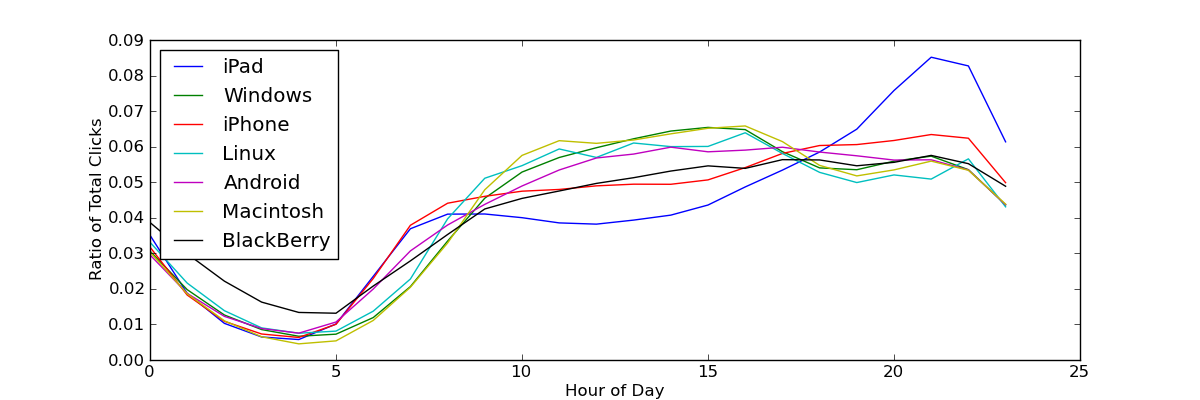
A study of click patterns by link-shortening service Bit.ly illustrates a distinct difference in usage between iPads and other types of devices, including smartphones and traditional computers. 

The general curve of most of the usage lines follows the general traffic flow of larger websites. Very little traffic at night, with a steep rise as the work day starts with a peak in the mid-afternoon, then a drop-off as people begin to leave work. Smartphone and desktop browser usage are fairly similar. 

iPad use, on the other hand, is dramatically different. Usage dips slightly after breakfast and remains below the other devices throughout most of the day, until the evening. Then it spikes much later in the evening. 


Bitly researcher Brian David Eoff: 

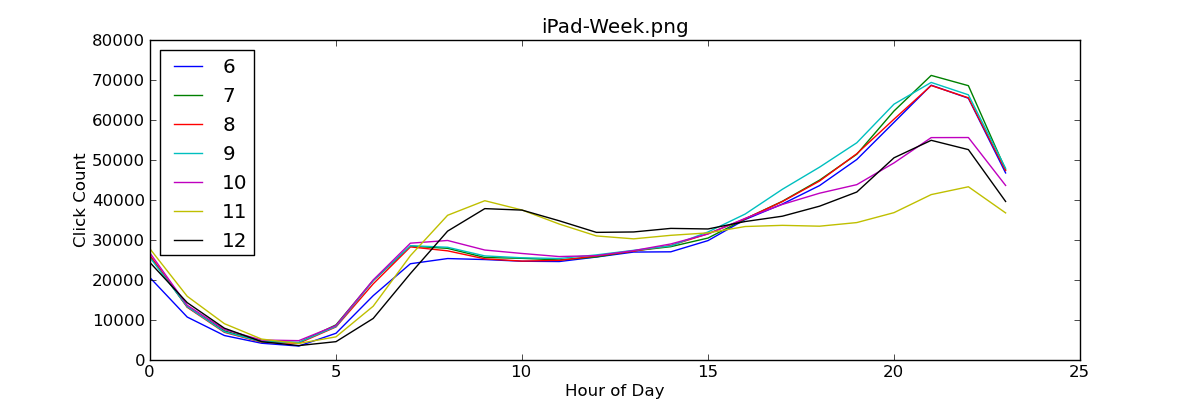
During the weekends iPad usage between 8 a.m. and 3 p.m. is higher than it is during the week at those same hours. No other device sees a heavy increase of use during the weekends, showing that the iPad is used as an entertainment device and differs from both smartphones and browsers.

Bitly also looked at the types of data consumed, but didn't see any drastic differences in behavior there. The most striking differences are in the times of use. Eoff believes it's because the iPad is "used as an entertainment device" more than both smartphones and browsers.

Sent from Mobile

Posted via email from Pete's posterous

Google Circles Intro

http://www.readwriteweb.com/archives/google_to_launch_major_new_social_network_called_c.php

Excerpt:

A Matter of Personas

With Circles, I believe that Google will attempt to accomplish something critics from the blogosphere,academia, SXSW 2010 keynoter danah boyd, privacy watchdogs and others have all called on the social networking world to do: to allow our online communication to respect the same boundaries that our offline social lives do.

School and work, friends and family, the sacred and the profane; we've always been able to communicate different things to different people in different circumstances. Facebook, Twitter and other online social networks have collapsed all those contexts into one big bucket. We speak to our "friends" all at once, no matter what we might want to say to one group of people or another. And thus we often feel less comfortable than we might saying anything at all.

This fundamental discomfort has been, many people argue, a limiting factor in the growth, reach and depth of online social interactions. If that problem could be solved, there are big new ways that the online world could grow and evolve. This has been a more sophisticated understanding of privacy, not just as a public/private dichotomy but as a matter of contextual integrity of communication, that we and others have been calling on Facebook to adopt for almost two years.

The development of Circles is likely heavily influenced by the work of ex-Google social technology researcher Paul Adams. Adams has written a book called Social Circles, which will be released this Summer and he published a widely read slide deck about what is wrong with social networking: specifically the lack of respect for context and personas. (The Real Life Social Network) Adams worked on User Experience at Google for four years, but just months after publishing his influencial presentation he left Google for Facebook.

Posted via email from Pete's posterous

Social Networks & Social Circles

Threadless.com Models Customer Driven Success

It’s A Pretty Big Ship: HP Isn’t After Apple, It’s After The Enterprise « CrunchGear